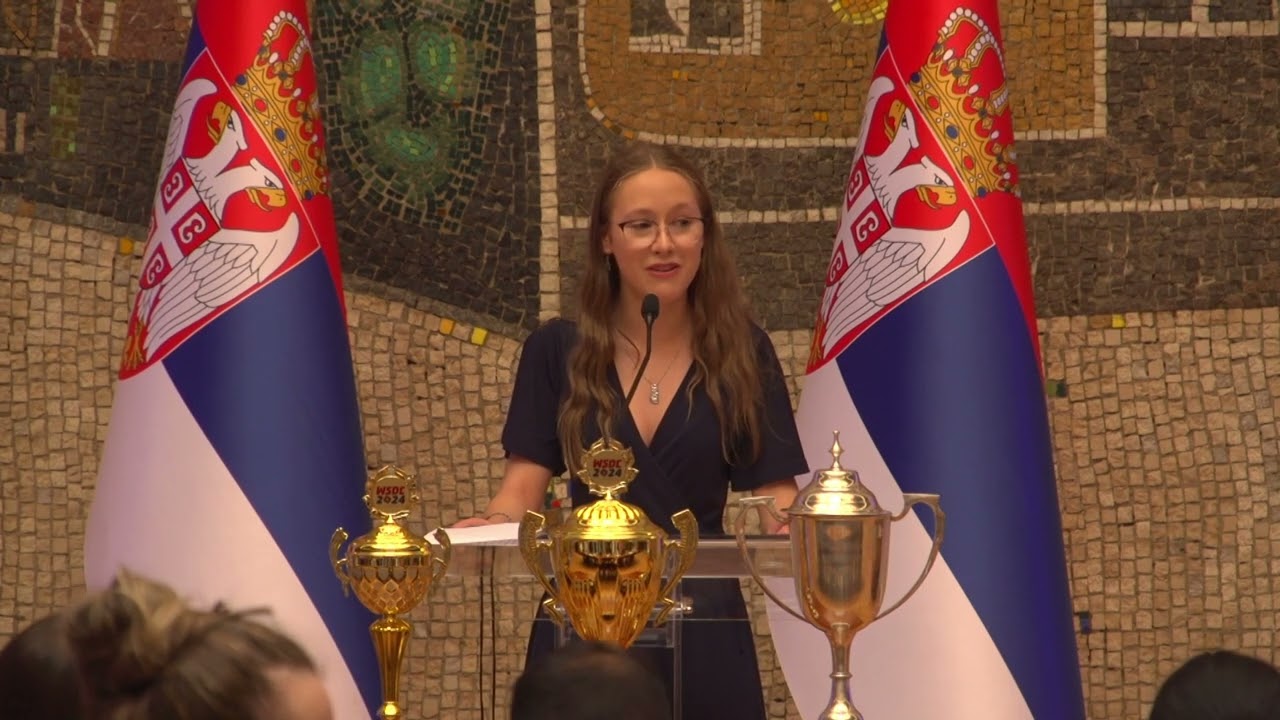
WUDC Semifinals 2025
- Motion: THW militarily intervene in Sudan
- Results: OO and OG advanced
- Video attachment:
This speech is transcribed by Arnav Agarwal for the Debating404 project.
DLO: Ryan Lafferty
Opening:
Opening government has no case
Their aim is to displace the RSF from Sudan. Problem. Who governs Sudan post the UN leaving? The likely answer is the SAF, according to OG’s analysis. Problem. Who committed the genocide in the early 2000s in the Darfur region? Hint: It was the S-A-fucking-F.
OG has no comparative. The best claim they make is that you temporarily reduce violence with zero explanation of the long-term benefit. Our case is simple. When the West intervenes, what you get is Somalia all over again. The West intervenes for 6 months. You temporarily increase violence. The West then leaves as the body bag effect kicks in. The resulting increase in violence, the increased power for radical Islamist groups to seize influence across the country, means the genocide gets worse.
OG is right, there is an epic humanitarian crisis in Sudan. That crisis gets worse on their side of the house. Do not let the rhetoric fool you.
First Question: will the intervention succeed? OG has three reasons. They are all silly.
Reason number 1:
The terrain in Sudan is favourable for an intervention.
Nonsense. There are two places where the conflict currently happens.
The first are major Urban centres like Khartoum and Port Sudan. Problem: Urban Warfare is notoriously impossible. If you don’t trust me, ask the people in Stalingrad in 1944 how they felt about Urban conflict. Why is Urban warfare difficult? Because the precision airstrikes that Manuel wants to prop do not work in urban areas. Hint: you know what happens when you try to do precision air strikes? You get Gaza. Mass humanitarian, civilian casualties. Because you cannot target specific sites. You lack intelligence about where forces are operating. Which means civilian casualties get worse on their side of the house. Which not only means you don’t displace the RSF, you kill civilians in the process.
Secondly, the violence is often occurring in underdeveloped rural areas in Darfur. The problem is that these areas are low-population-density zones. That means that in order to create opening government’s humanitarian corridors, you need a huge mass of peacekeepers. Tens of thousands of soldiers manning the guardrails. Why is that a problem? There is no political will for that scale of intervention. At best, you get what Haiti is currently experiencing. Kenya promised 2500 peacekeeping forces by January of 2024. It is now January of 2025; there are fewer than 1000 UN peacekeeping forces.
Here’s the reason you will never get the scale of intervention needed for OG’s benefits. Because they want this to be a UN-led operation. Problem: UN peacekeeping operations, by definition, cannot be offensive. They can only be defensive in nature. The problem is you must recapture territory by OG’s own concession. So, the UN lacks the internal political will to justify the large-scale intervention supported by OG.
Problem number two, the African and Western militaries that they want to back this intervention do not have the military capacity to operate effectively in Sudan. Why is that? The major African militaries that could back this are bogged down by high levels of inflation, high levels of youth unemployment, political instability, CF, the Kenya protests this summer where the parliament building was literally stormed, and internal armed insurgencies. But the Western militaries they want to intervene are also unlikely to back this on a large scale. Not only because of the body bog effect that I’ve already described, but also because the West has other priorities it is more interested in; for example, the Trump Administration will pivot increasingly towards East Asia and deterring conflict in Taiwan, which means the level of backing opening government realistically gets in the long term is limited. Why is this a problem? In addition to the fact that there are other UN peacekeeping operations that get defunded or lose personnel as you reallocate soldiers, for example, from Haiti to Sudan, you get limited benefits on their side.
The second argument opening government makes for why this works is that you deter abuses because there are boots on the ground.
I’ll flip this argument in four ways and explain why abuse is worse on their side.
Flip number one: Hemedti, the leader of the RSF, is a strongman leader who has staked his reputation and image as being a strongman. When the West intervenes, that strongman image can only be maintained if he doubles down on violence to show he is not scared or deterred by the presence of UN peacekeepers. Which means, if anything, even if violence is strategic in certain areas, for example even if it’s strategic to engage in mass civilian slaughters in areas controlled by the RSF, there is now an incentive to do so to not appear weak.
Flip number two. They say they want to kill the leaders of rebel groups. This is worse because if you kill the leaders successfully, by the way never proven that you have the capacity to identify, track, and kill these leaders, then this causes groups like the RSF to fracture and splinter when their leadership disintegrates. Problem: when you fracture rebel groups, the resulting consequence is more violence because you increase inter-rebel violence and inter-rebel conflict. Which means not only do you get a genocide in Darfur, you also get a genocide throughout the remainder of the country. So even though there is violence in Sudan currently, you expand the geographic scale at which that violence operates.
Flip number three. Western military forces are highly likely to commit mass human rights abuses. Why is this? Setting aside the empirically obvious fact that every major UN peacekeeping operation has been besieged by sexual assault of young women on the ground and high levels of civilian casualties, it is because this intervention requires high levels of civilian casualties. Why is that? Because the RSF embeds itself amongst civilian populations to deter air strikes from rival forces. This means that you necessarily must kill thousands of civilians to even enter Sudan on their side of the house.
Flip number four. UN peacekeepers are highly likely to be killed en masse on their side. Why is that? Because the RSF knows that the UN is likely to reduce the scale of its involvement if its casualties become sufficiently high. So there is a huge incentive to kill as many UN peacekeepers as possible, which is why the Kosovo example doesn’t work because it’s not air strikes; it’s police officers, they can be killed.
Opening Government’s final reason why this works is that you deter the UAE from funding the RSF.
Flip this argument. The fact that the West is now militarily intervening in Sudan makes this a de facto proxy conflict for the anti-Western axis of resistance to fight back against Western intervention. Think about what Iran, Russia, China, and North Korea do in response to this policy. It is to increase arms sales towards the RSF. You might say, aha, but Russia can’t do that; the war in Ukraine is happening. No, the war in Ukraine probably ends this year, because Trump has backed and promised to end all aid to Ukraine. So, the largest militaries in the world, Russia and China, are likely to increase their level of involvement.
POI
POI – You haven’t proven you get a positive case. You’ve provided no reason to believe the RSF ever stops support.
Yeah, so let’s chat about the comparative, but I just want to be clear. There are no good guys in Sudan. There is no good ending to this conflict. Our claim at opening opposition is not, and closing opposition cannot seriously claim we end the war. This is ridiculous. Neither team does. This is a question of there are people who will die in OG’s world that do not die on our side. There is a genocide ongoing; this does not justify creating a second genocide in the country.
Counterfactual:
But let’s chat about the counterfactual.
Why can it get better under our side? Two reasons.
First, mediation is likely to work in the long term. Because the origins of this conflict are not that complicated. The RSF and SAF disagree on the timeline for reintegration into a single military force in Sudan. When the West pivots away from the conflict in Gaza, or broadly if the Trump administration reduces its care for Israel, the consequence is increased diplomatic focus on mediating a reintegration timeline for the RSF and the SAF. No, this is not guaranteed to work, but it’s probable it could. Why is that the case? First, there are strong economic incentives for both sides to eventually acquiesce to a deal. Conflict is costly. You face huge levels of sanctions, and there are therefore rational selfish economic incentives for leaders of both the RSF and the SAF to eventually agree to come to the table.
But secondly, over time the SAF is going to pivot away from more fighting. Its aim is to become a governing body. It does not want to be sanctioned and massed by the West because it saw what happened to Omar Al-Bashir when he engaged in a genocide. Hint: he got couped. Their incentive is to moderate.
There is no benefit to Gov. The situation gets worse. Oppose.